
Our Beneficiaries
We believe that simply being born into poverty should not dictate the end of an individual's story. Central to our mission is ensuring that women, children and young adults from impoverished communities in Kenya can embrace hope for their futures.
We provide hope for orphans, children and young adults who were born into under-resourced families and impoverished communities. At the time of selection, our beneficiaries meet the criteria for poverty as defined by the United Nations:
“Poverty entails more than the lack of income and productive resources to ensure sustainable livelihoods. Its manifestations include hunger and malnutrition, limited access to education and other basic services, social discrimination and exclusion, as well as the lack of participation in decision-making.”
We place special emphasis on empowering women and girls to strive for gender equality and boost economic growth, which allows for individuals to break out of the poverty cycle in the communities where we work.

The Problem
The nation of Kenya is populated by highly motivated, creative and intelligent people. However, with 26% of the population falling under the poverty line, opportunities for the Kenyan people are limited by barriers to education and opportunity. Additionally, historical systems and cultural practices limit the empowerment of impoverished individuals, as well as the aspirations of many girls and women in their communities. According to the World Bank Global Poverty data, the percentage of people living under the poverty line in Kenya increases without access to education.
46% percent of adults who have not received a primary school education fall below the poverty line, compared to 14% of high school educated adults and just 3% of adults who have achieved post-secondary education (university and technical training).
Big Ideas,
Real Impact.

Our Solutions
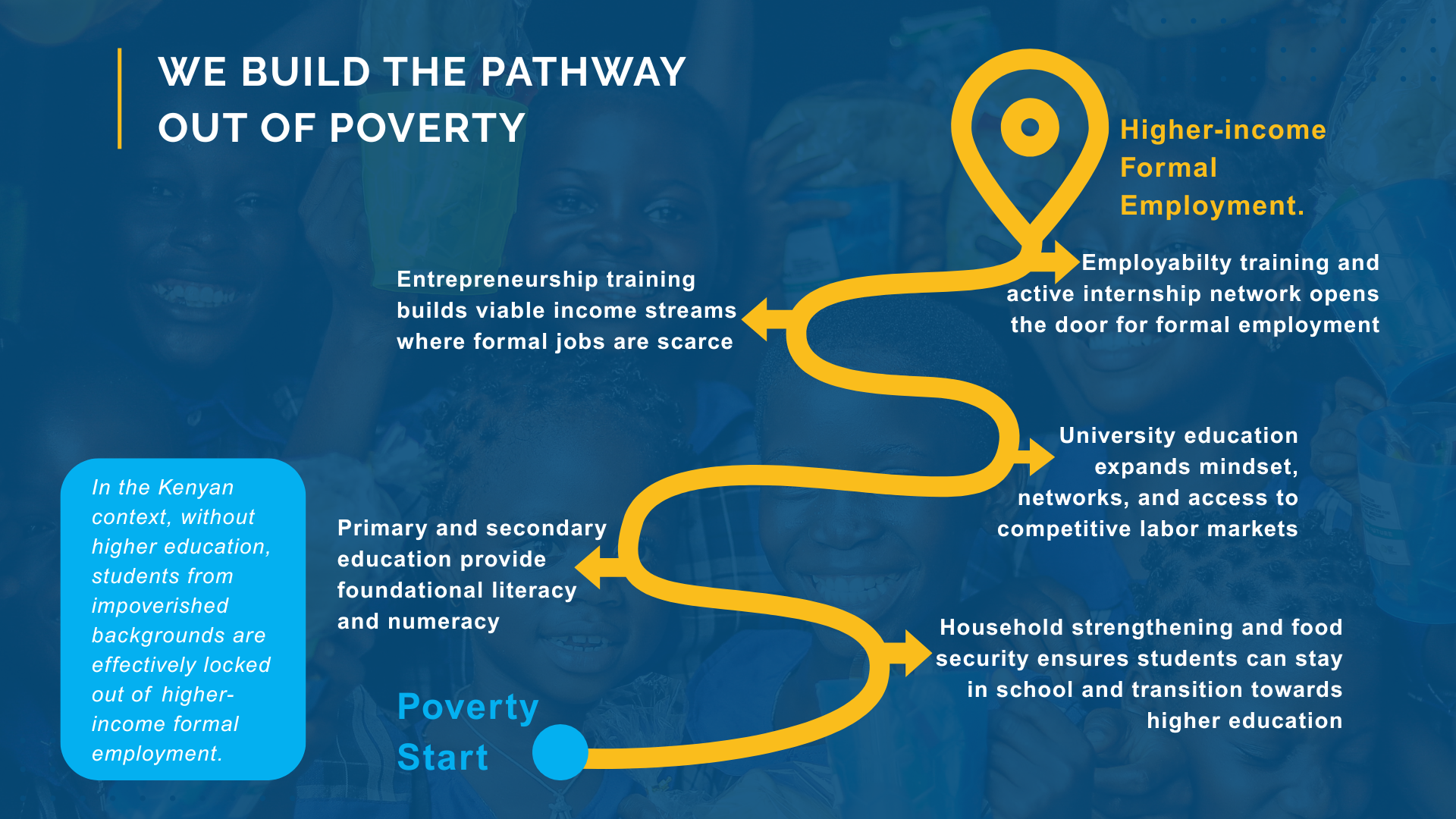
Through culturally informed programming, we provide tools that help individuals and communities flourish and break out of the cycle of poverty through the following interventions:
Strengthen Households
We strengthen households to remove the 'poverty tax' on new graduates. When a family is self-sufficient, the student is free to transition from a degree-holder to a high-earning professional without the weight of immediate financial dependence.
Access to Education
Provides the knowledge and skills needed for economic advancement by unlocking the academic and social requirements for higher paying and stable employment.
Pathways to Employment
Our model shatters the glass ceiling for Kenyan youth with a 78% Success Rate in a 20% Economy. We pair foundational financial literacy with direct employer pipelines, ensuring our graduates secure jobs or create them